Best Garage Floor Coating: Epoxy vs. Polyaspartic (2026)
Which garage floor coating actually holds up in the Texas heat? An honest comparison of paint, epoxy, and polyaspartic from a North Texas crew.
Search “best garage floor coating” and you get a wall of product ads and top-ten lists, each one pointing at whatever the site is selling. The right coating depends on what you need the floor to survive, and a slab that bakes through a North Texas August has different needs than a garage up north.
We coat floors around Hood and Parker County every week. Each option below holds up to something different, and the best one for you comes down to your slab and your summers.
The short answer
The best garage floor coating for most Texas homeowners is a full flake system: a diamond-ground slab, an epoxy base coat, a full broadcast of color flake, and a UV-stable polyaspartic topcoat. It costs more than a can of paint or a big-box kit, and it lasts 15 to 20+ years instead of one or two summers.
Garage floor paint
Latex or oil-based porch-and-floor paint is the cheapest option, a few dollars a square foot in materials. It rolls on like wall paint and dries to a thin film. It wears through where you walk and park, peels when moisture pushes up through the slab, and can’t take a hot tire. Paint hides a stained floor for a season, then wears off.
1-part epoxy (the DIY kit)
The kits at the hardware store are water-based or 1-part epoxy, a step up from paint for $150 to $600. The catch is prep and thickness. Kits tell you to acid-etch the slab, which is a weak substitute for grinding, and they lay down thin. In Texas heat that combination lifts at the edges and yellows in the sun within a couple of years. It works for a rental you’re flipping and disappoints on a floor you want to keep.
2-part epoxy (professional grade)
Real 2-part epoxy is the base most good floors are built on. Ground into a properly prepped slab, it bonds hard and holds a flake broadcast well. Epoxy has one weakness on its own: raw UV light yellows it over time, and it scratches. So we treat a bare epoxy floor as the base coat and seal it under a topcoat rather than leaving it exposed.
Polyaspartic and polyurea
Polyaspartic is the topcoat that made these floors last. It cures fast, stays clear under UV, resists chemicals and hot-tire pickup, and takes abrasion better than epoxy. Some crews lay polyaspartic straight over the slab as a one-day job. We use it as the sealing topcoat over an epoxy base and flake, so the epoxy gives the bond and the polyaspartic gives the armor.
The full flake system
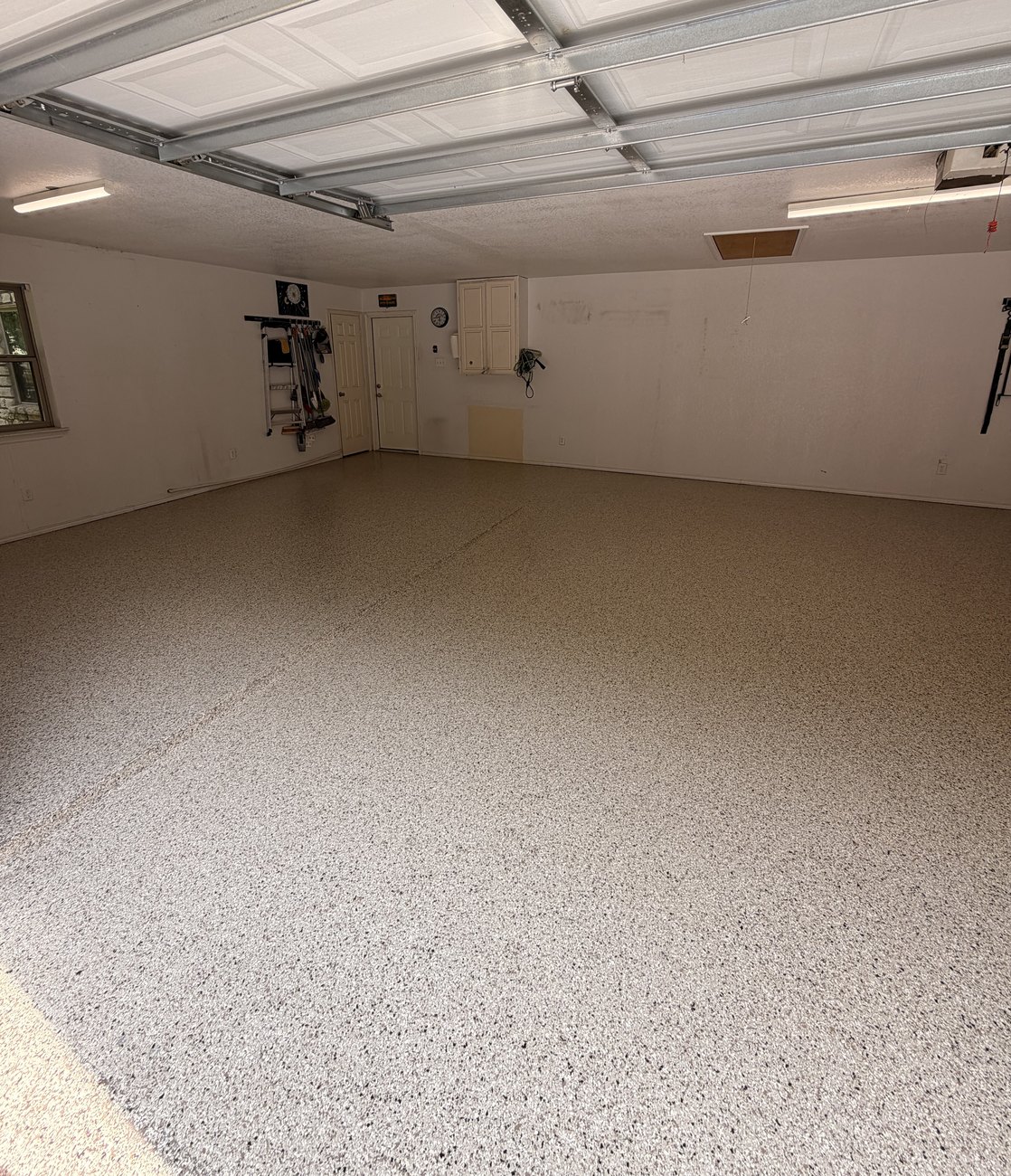
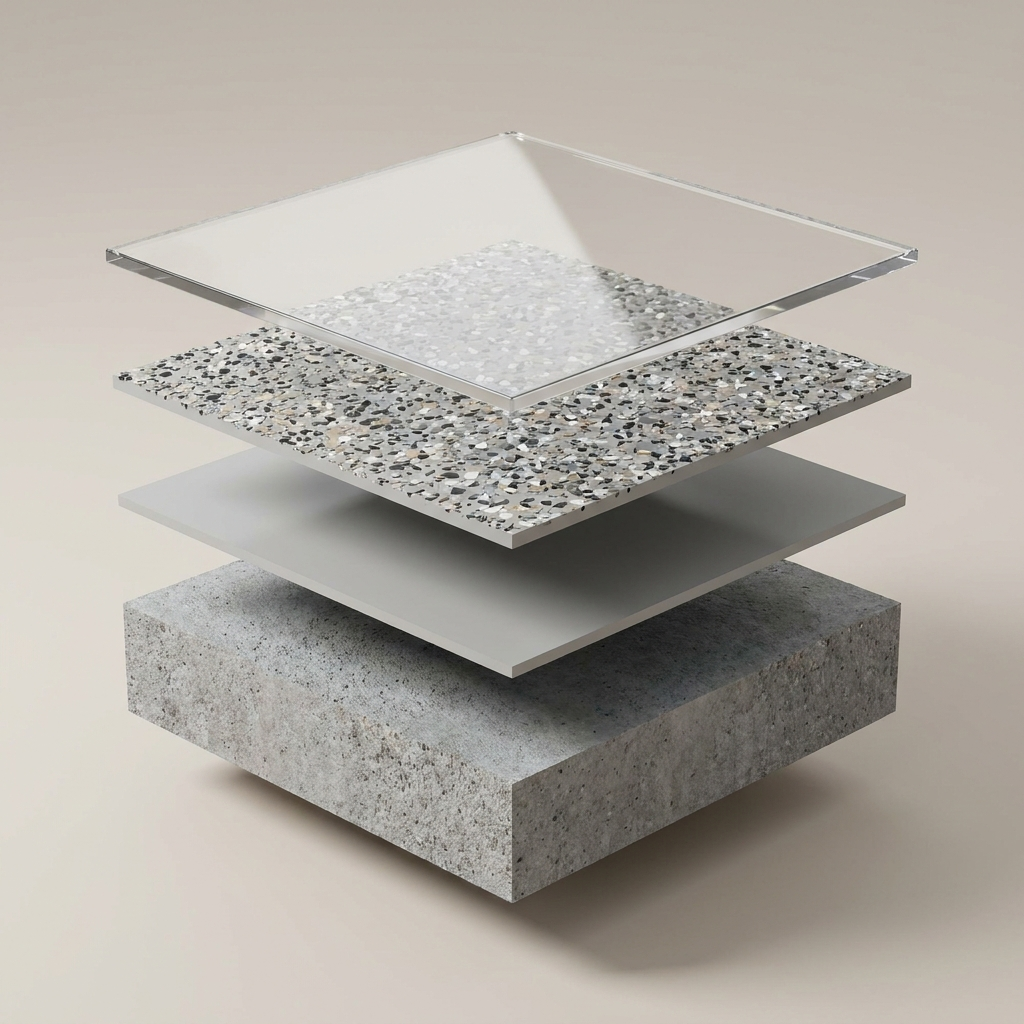
Stack the strong parts and you get what we install: ground concrete, epoxy base, full color flake, polyaspartic topcoat. The flake earns its keep beyond looks. It adds grip underfoot and hides the small stuff a garage floor collects. Pick your color from dozens of flake blends, and the topcoat locks it all down.
How the options compare
| Coating | Up-front cost | Lasts (Texas) | Hot-tire pickup | UV yellowing |
|---|---|---|---|---|
| Floor paint | $ | 1 to 2 years | Fails | Yes |
| DIY epoxy kit | $ | 1 to 3 years | Common | Yes |
| Pro 2-part epoxy | $$ | 5 to 10 years | Some | Over time |
| Polyaspartic system | $$$ | 15 to 20+ years | Resisted | No |
What “best” means in the Texas heat
A coating that wins a magazine test can still fail in a Granbury garage. Two things kill floors down here: hot-tire pickup and moisture. Tires come off a summer highway hot enough to grab a weak coating and peel it. Moisture pushes up through an unsealed slab and breaks the bond from underneath.
The full system handles both. The diamond grind opens the concrete so the epoxy bonds into it, not just onto it. The polyaspartic top shrugs off the hot tires and the sun. The crews we send out grind, repair, and coat over two days, the same in Granbury as in Weatherford.
What it costs
The best coating is the one you don’t have to buy twice. A full flake system runs $5 to $9 a square foot installed, and a two-car garage lands around $3,000 to $3,600. We walk through every number in our garage floor cost guide.
The bottom line
The best garage floor coating fits your slab and your summers. For most North Texas garages that’s a ground, epoxy-based, flake-broadcast floor sealed under polyaspartic. It costs more than paint or a kit up front, and it’s still on the concrete long after those have peeled off.
Common questions
What is the most durable garage floor coating?
A polyaspartic topcoat over an epoxy base. It resists hot tires, chemicals, and UV, and lasts 15 to 20+ years in the Texas heat. On its own, paint or a single-coat kit lasts a fraction of that.
Is polyaspartic better than epoxy?
As a topcoat, yes. Polyaspartic stays clear under UV and cures harder than epoxy. Epoxy is the better base coat for bonding and holding flake. The strongest floors use both together.
What is the best garage floor coating for a hot climate?
A full flake system with a UV-stable polyaspartic topcoat. It handles the hot-tire pickup and sun that make cheaper coatings peel and yellow in a summer or two.
Is epoxy or paint better for a garage floor?
Epoxy, by a wide margin. Paint is a thin film that wears where you walk and park. Epoxy bonds into the slab, and sealed under polyaspartic it lasts for years.