Commercial Epoxy Flooring: Cost and What Holds Up
A commercial floor takes abuse a garage never sees. How commercial epoxy flooring is built, what it costs, and what actually holds up.
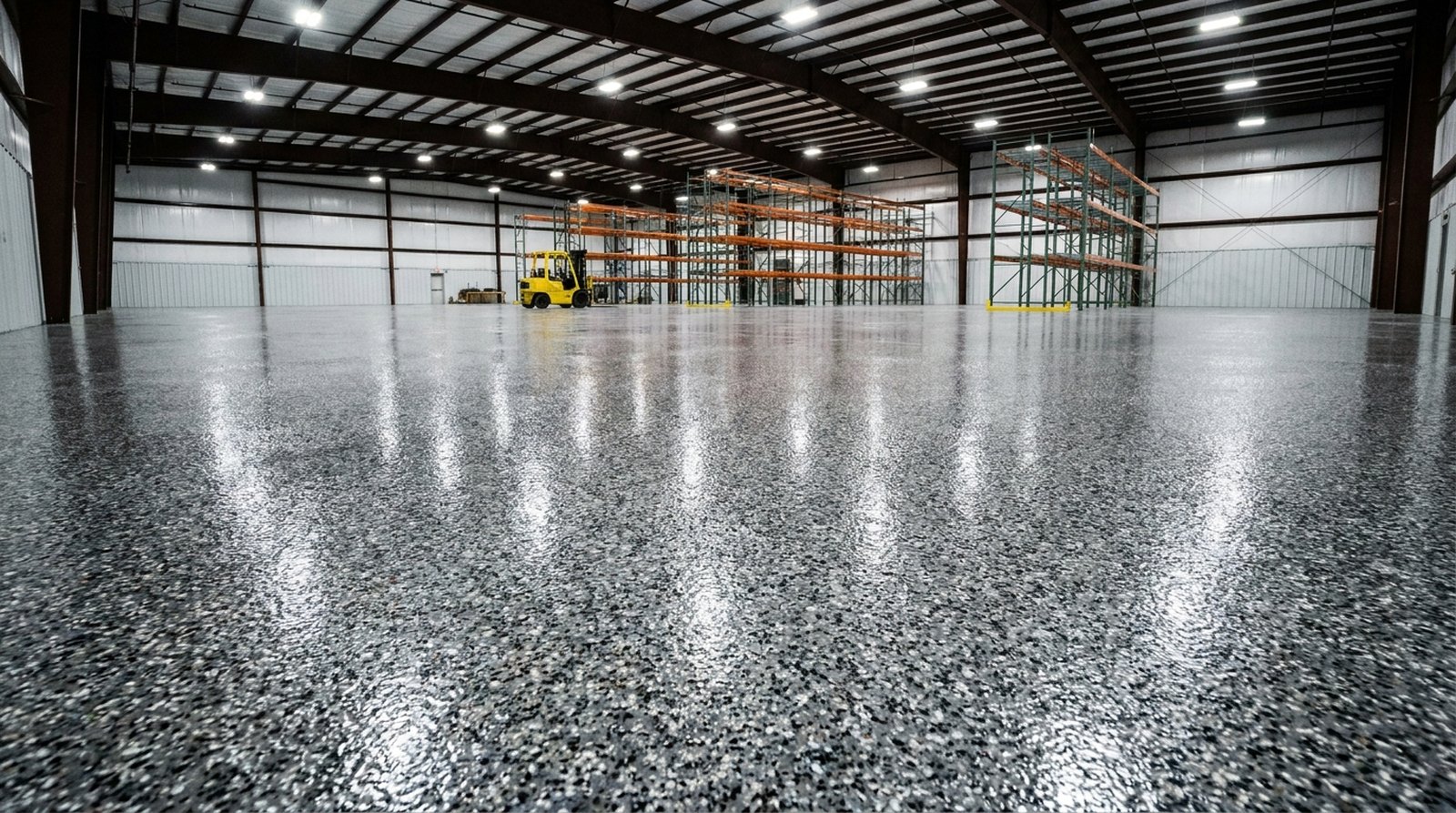
A commercial floor lives a harder life than any garage. Forklifts, pallet jacks, steel-wheeled carts, dropped tools, spilled chemicals, and foot traffic that never stops. Then a coating either holds up to all of it or it starts failing in the traffic lanes within a year.
The stakes are different too. When a garage floor peels, it’s an eyesore. When a warehouse floor peels, you’re shutting down a section of your operation to fix it. So the decision is less about color and more about what survives the way you actually use the building.
What makes a commercial floor different
Four things separate a commercial job from a residential one:
The loads are heavier and concentrated. A forklift puts thousands of pounds on four small wheels. A pallet jack drags steel across the floor. Those point loads punch through a thin coating that a car would never bother.
The chemicals are constant. Depending on the space, the floor sees oil, solvents, cleaning acids, battery acid, food waste, or all of it. A residential floor sees that on a bad day. A commercial floor sees it on a schedule.
Downtime costs money. You can leave a car in the driveway for two days. You can’t always shut a working floor down, which changes how the job gets planned.
The slab is often older and rougher. Warehouse and shop slabs were poured for function, not looks. More grinding, more crack repair, more contamination to pull out before anything bonds.
How a commercial epoxy floor is built
The system is the same one we use everywhere, sized and specced for the abuse a commercial floor takes:
- Diamond-ground concrete. We grind the slab to an aggressive profile so the coating keys into it instead of sitting on top. On a commercial floor this matters more, not less, because the loads are heavier.
- Crack and joint repair. Older slabs move and crack. We fill them before coating instead of letting them telegraph through.
- A high-build epoxy base. This is the layer that carries the load and stands up to moisture pushing through the slab. On heavy-traffic floors we build it thicker.
- Full flake broadcast and a UV-stable polyaspartic topcoat. The flake gives grip and hides wear. The polyaspartic takes the chemicals, the traffic, and the sun through the loading door.
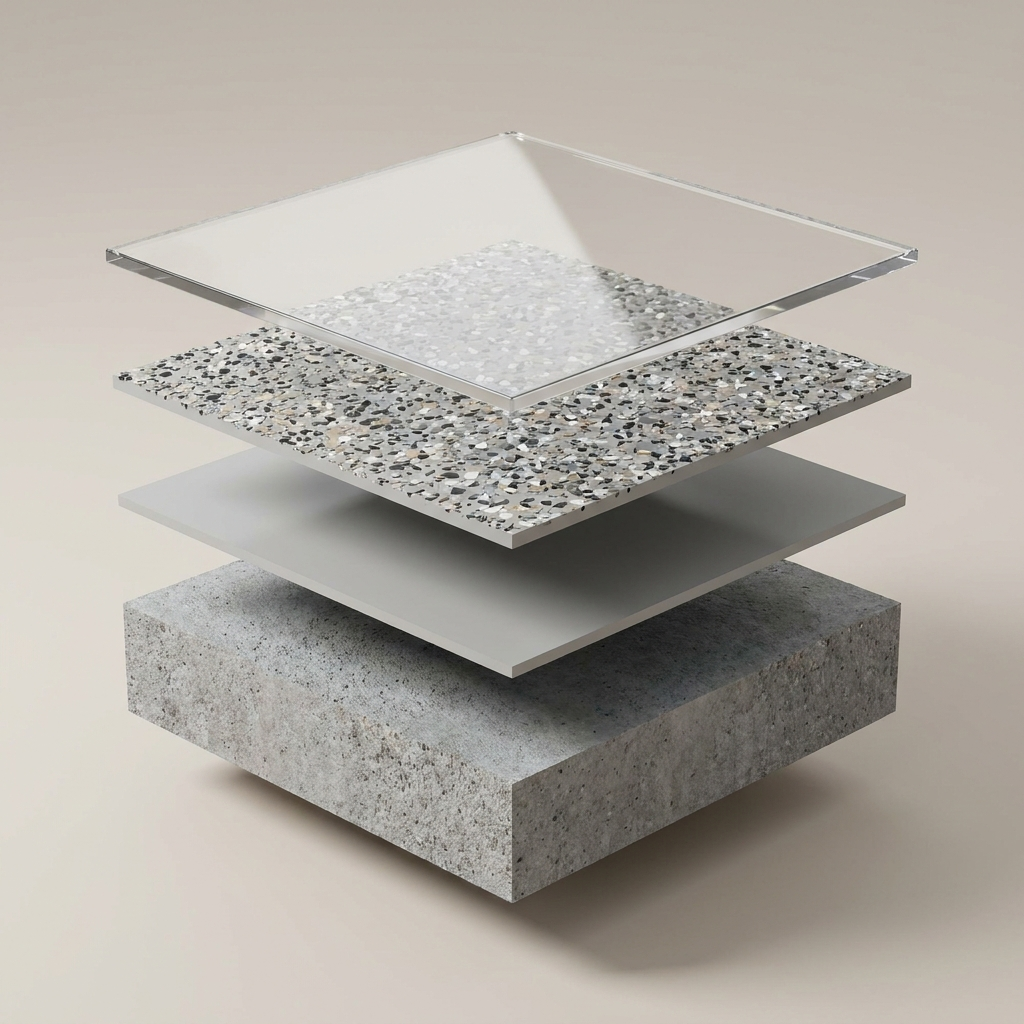
For spaces that need it, we can add non-slip aggregate for OSHA traction, cove the base up the wall for washdown areas, and build extra thickness in the forklift lanes.
What it costs
Here’s the honest answer nobody in the industry likes to give: a commercial floor doesn’t have a flat price.
A clean, sound warehouse slab that needs grinding and a standard coating runs at the lower end. A commercial kitchen that needs coving, extra thickness, a non-slip surface, and washdown-ready detailing runs higher. The square footage works in your favor at scale, but the prep and the specs move the number more than the size does.
What drives a commercial quote:
- Slab condition. How much grinding, how many cracks, how much oil to cut out.
- The use. Forklift traffic, chemical exposure, food prep, and washdown all add spec.
- Thickness. Heavy traffic wants a thicker build than a retail showroom.
- Downtime. Phasing the work around your operation takes longer than a shutdown.
Send us the square footage and a straight description of how the floor gets used, and we’ll get you a real number. We break down what goes into residential pricing in our cost guide, and the same logic scales up.
Epoxy flake vs. polished concrete
Epoxy isn’t the only commercial floor worth considering, and you should know the other option before you spend the money.
Polished concrete is the slab itself, ground and densified to a sheen. There’s no coating on top, which means there’s nothing to delaminate, chip, or lift. It suits big-box retail, warehouses, and showrooms where the slab is sound and you want the lowest long-term maintenance.
Epoxy flake puts a new surface on the concrete. You get color, a fully sealed floor, real chemical resistance, and a finish that hides wear. It suits shops, kitchens, light industrial, and anywhere the slab is stained or the surface needs to resist what gets spilled on it.
| Epoxy flake | Polished concrete | |
|---|---|---|
| What it is | A bonded coating system | The slab itself, ground and densified |
| Color options | Dozens of flake blends | The concrete’s natural tone |
| Chemical resistance | Strong | Fair, the densifier helps |
| Can it delaminate | Bonded to a ground slab | Nothing to delaminate |
| Best for | Shops, kitchens, light industrial | Retail, warehouses, sound slabs |
| Maintenance | Clean and reseal the topcoat over time | Periodic re-burnish |
Neither wins across the board. The right call comes down to your slab and how the space gets used, and a floor company worth hiring will tell you when your building points one way or the other instead of selling you whatever they happen to install.
Two honest limits
Same as any floor, we’d rather tell you now than after.
Moisture kills coatings, at any scale. A lot of slabs around here went down without a vapor barrier, and water wicking up through the concrete lifts a coating no matter who installs it. We meter every floor for moisture before we coat it, and on a big commercial slab that test is the difference between a floor that lasts and a callback that shuts your operation down. It’s the same failure that kills 1-day polyaspartic floors, just more expensive when it happens on a warehouse.
A failing slab is a concrete problem, not a coating problem. If the floor is heaving, badly spalled, or cracked from settling, a coating won’t fix the cause. We’ll tell you if that’s what we’re looking at before anyone takes a deposit.
Why coat a commercial floor at all
Beyond looks, three things a business owner notices fast:
- It cleans up. Sweep it, hose it, wipe up the spill. No more concrete dust coming off a bare slab onto product and equipment.
- It’s safer. A flake floor with the right additive gives traction where a bare or painted slab gets slick.
- It lasts. A properly built floor outlives the equipment you run on it, which on a commercial slab is the whole point.
The bottom line
A commercial floor takes more than a garage, so it needs more than a rolled-on coat. Grind the slab, test it for moisture, bond a thick epoxy base into it, and seal it under flake and polyaspartic. Spec the thickness and the traction to match how you actually use the building, and you get a floor that survives the forklifts and the chemicals instead of failing in the lanes.
See what we install and how we sequence a job on our commercial floor coatings page, or go straight to warehouse flooring if that is your building.
We coat commercial floors, shops, and warehouses across Granbury, Weatherford, Stephenville, and Glen Rose. Send us the square footage and how the space gets used, and we’ll get you a number.
Common questions
How much does commercial epoxy flooring cost?
It depends on the slab and the use. A clean warehouse floor that just needs grinding and coating runs less per square foot than a food-prep space that needs coving, extra thickness, and a non-slip additive. We quote off the dimensions and how the floor gets used, rather than a flat rate, because a 10,000 square foot warehouse and a commercial kitchen are two different jobs.
How long does a commercial epoxy floor take to install?
Our base system is two days: grind and prep day one, coat and cure, topcoat day two. Bigger floors take longer, and we can phase the work section by section so you don't shut the whole operation down. Full cure before heavy traffic and forklifts is a few days after the topcoat goes on.
Will a commercial epoxy floor hold up to forklifts?
A properly ground and bonded system handles forklift traffic, pallet jacks, and steel wheels. What fails is a thin coating over weak prep, where the point load punches through. Thickness and bond carry the weight, which is why the grind and the base coat matter more than the color.
Is epoxy or polished concrete better for a commercial floor?
Depends on the building. Epoxy flake gives you color, chemical resistance, and a sealed surface that hides wear. Polished concrete has no coating to fail, so it suits high-traffic retail and warehouses where the slab is sound and you want the lowest long-term maintenance. Neither is better across the board; they solve different problems.
Do you coat commercial floors around Granbury?
Yes. We coat shops, warehouses, retail spaces, and light industrial floors across Granbury, Weatherford, Stephenville, and the surrounding Hood, Parker, and Erath County area. Send us the square footage and how the space gets used and we'll get you a number.