Polyaspartic vs. Epoxy: The Truth About 1-Day Floors
Why 1-day polyaspartic garage floors peel in the Texas heat, how a 2-day epoxy-and-polyaspartic system holds up, and what the warranty fine print hides.
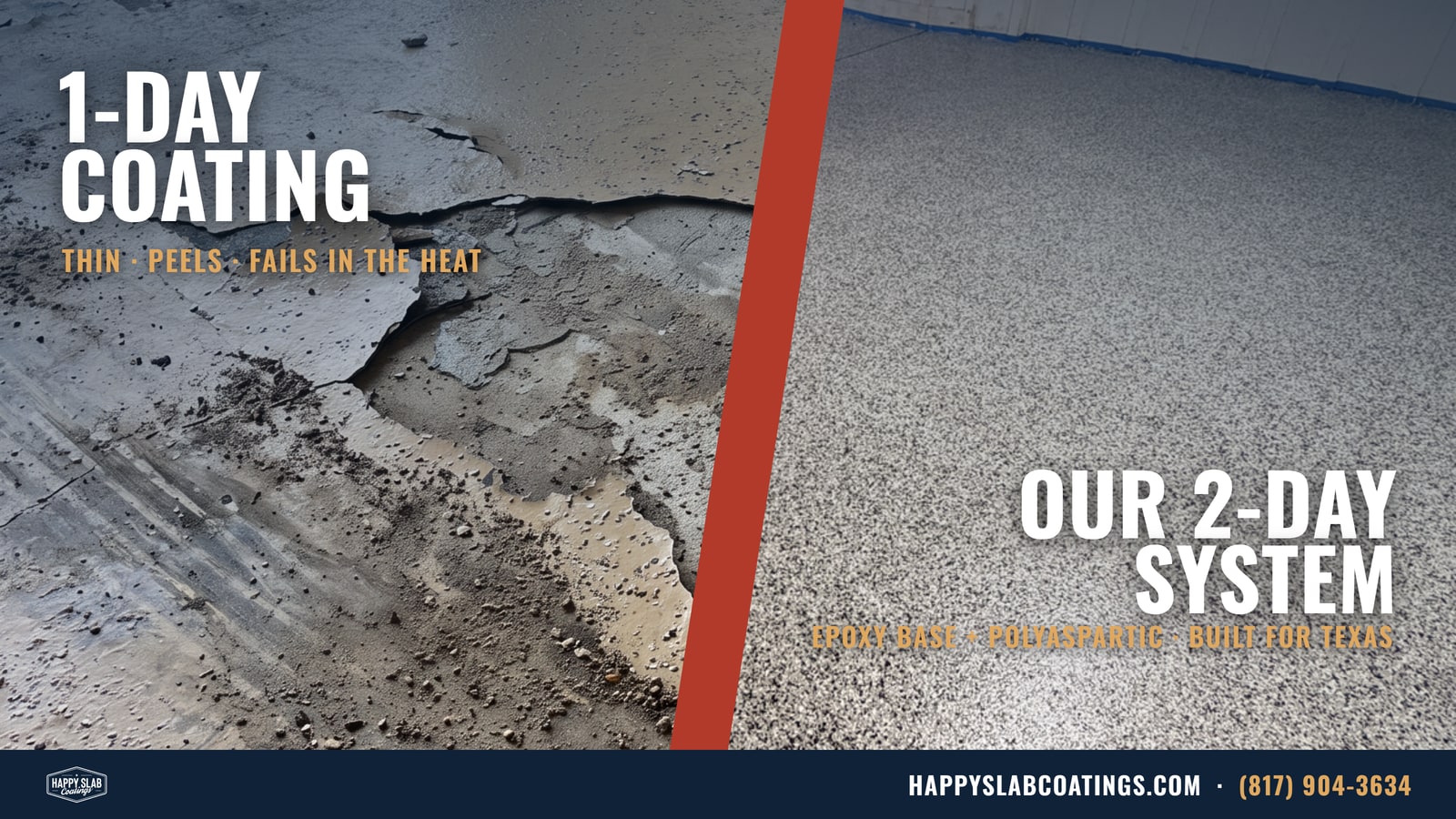
A one-day garage floor sounds great. The crew shows up in the morning, you park on it that weekend, done. That speed is the whole sales pitch, and in the Texas heat it’s also the problem: the fast version is the one that peels.
The whole difference comes down to one layer. A 2-day system bonds a moisture-barrier epoxy into your slab. A 1-day system skips it. If a company just quoted you a floor “done in one day,” here’s the comparison first, then why that one layer decides whether your floor lasts.
1-day vs 2-day, side by side
| ”1-day” system | Our 2-day system | |
|---|---|---|
| Base coat against the slab | Thin polyaspartic that flash-cures on the surface | Thick epoxy that keys into the ground concrete |
| Bond to the concrete | Weaker, sits mostly on top | Stronger mechanical bond down into the pores |
| Moisture protection | None dedicated | Moisture-barrier base, and we meter the slab first |
| Hot-tire pickup | Common failure | Resisted |
| Warranty on moisture | Usually excluded | Covered in writing |
| Install time | 1 day | 2 days |
| How long it lasts | Often peels in a few years | 15 to 20+ years |
The base coat is where the two systems really split. Both crews grind the slab first, but what goes down next is different. A 1-day system uses a thin polyaspartic base that flash-cures in minutes. It sets so fast that it never soaks into the open pores of the ground concrete, so it bonds to the surface instead of locking into it. Our epoxy base is thicker and has the working time to wet down into those pores and grab hold, which gives a stronger mechanical bond and a moisture barrier at the same time. That base is the layer that fights the most commonly cited cause of coating failure on a slab. Here’s what the two days actually buy you:
- A diamond-ground slab, with cracks repaired.
- A high-build, 100% solids epoxy moisture-vapor-barrier base coat that bonds into the ground concrete and holds back the vapor a thin coating can’t. We lay it only after the slab meters at or below 4% moisture.
- A full flake broadcast in the color you pick.
- A UV-stable polyaspartic topcoat that takes the sun and the hot tires.
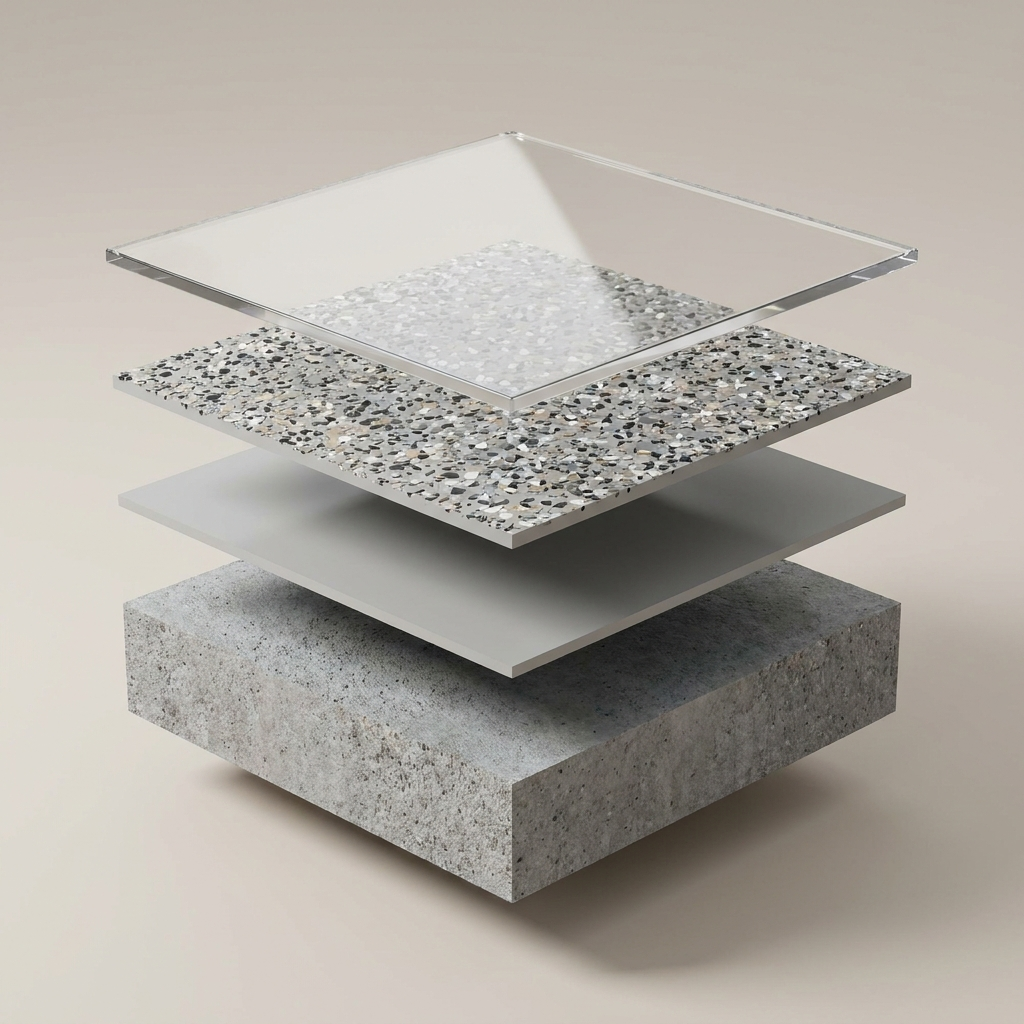
Epoxy is the better primer and polyaspartic is the better topcoat, so we use each for the job it does best. The epoxy base has to cure overnight before the polyaspartic goes down, which is the only reason the install takes two days. That cure time is what makes the floor last, not a delay to apologize for. You can read the full layer-by-layer system here.
”4x stronger than epoxy,” and what that claim actually means
Somewhere in your 1-day quote you’ll probably see “4x stronger than epoxy.” Sometimes it’s 20x. It’s the most repeated line in this whole category, and there is no study behind it.
When installers pulled the manufacturer data sheets and compared them, epoxy ties or beats polyaspartic on every measure that word “stronger” implies: tensile strength, compressive strength, and hardness. A high-solids epoxy is often the harder, higher-strength material on paper.
So where does “4x” come from? The one place polyaspartic wins is abrasion resistance, how well the surface shrugs off wear, where it runs about three to four times better than a standard epoxy. It’s also more flexible. Both are worth having in a topcoat. But “resists wear about four times better” got rounded off into “4x stronger,” which sounds like it will take a heavier hit, and it won’t.
The part that matters for your decision is what that line is doing. The companies leaning on “4x stronger” are using it to talk you out of an epoxy base coat. They take a wear number, relabel it strength, and use it to sell you a single thin layer instead of the exact base coat that would have handled your slab’s moisture. The honest version is simpler: polyaspartic is the better topcoat, epoxy is the better base, and a floor that uses both beats a floor that picks one and markets around the gap.
Why 1-day floors peel in Texas
A 1-day install uses polyaspartic (or polyurea) for everything: a thin, fast-curing base coat, flakes, and a thin clear coat on top. No epoxy base. It’s fast and it uses less material and labor, which is exactly why it’s profitable to sell.
The problem shows up months later. Concrete is porous, and water wicks up through it in a process called moisture vapor transmission. As it does, pressure builds under the coating. A thin polyaspartic film laid direct-to-concrete has little to resist that pressure, so it starts to lift and peel. Add a Texas summer, where tires come home hot enough to grab a weak coating, and the failure speeds up. Moisture and poor surface prep are the two problems blamed most often when a coating lets go, and they’re connected, because prep is when you’re supposed to find the moisture. A thin 1-day floor is exposed on both counts.
The warranty fine print
Most 1-day installers hand you a long guarantee, sometimes 15 years or lifetime. Read it and you’ll usually find an exclusion for “moisture-related issues” and “hydrostatic pressure,” and sometimes for hot-tire transfer. Those exclusions cover the exact failures that thin polyaspartic-on-concrete is prone to. A warranty that excludes the most common way a floor fails isn’t worth much.
So before you compare one warranty’s length against another’s, read what it actually covers. A 15-year or lifetime number means nothing if it excludes moisture, because moisture is the failure these coatings get blamed for most. A shorter warranty that pays when the floor lifts is worth more than a lifetime one that writes that failure out. Length is the easy thing to put on a flyer. Coverage is the thing that matters.
The question worth asking any installer: if you’re confident in a 1-day floor, why won’t you warranty it against moisture and hot tires? For the full breakdown of what “lifetime” actually covers, read the truth about lifetime garage floor warranties.
Will my garage floor turn yellow?
This is worth clearing up on its own, because the yellowing worry talks people out of a better floor for the wrong reason.
Epoxy only yellows when bare epoxy takes steady direct sun. On a garage floor, none of that happens. The epoxy is a base coat, inside a garage, out of the weather. We broadcast flake into it until the floor rejects any more, which buries roughly 99% of the epoxy so the sun never reaches it. Then the whole thing is sealed under a polyaspartic topcoat that is UV-stable by design, so the only layer the sun ever touches is the layer built to take it.
The yellowed floors you have seen are the ones where a company used epoxy as the topcoat and left it exposed. That does fail, and it is exactly why we don’t do it. On our system the sun never sees the epoxy, and the layer it does see does not yellow.
Polyurea, polyaspartic, and moisture-barrier epoxy, in plain English
Once you start getting quotes, three words get thrown around: polyurea, polyaspartic, and epoxy. Here is each one without the sales gloss.
Polyurea is a coating known for curing almost instantly, sometimes in seconds. That speed is a big reason it shows up in 1-day systems. The trade-off is that the fast cure is hard to place well, and the cheaper “aromatic” version is not UV-stable, so on its own it ambers and fades in sunlight.
Polyaspartic is a type of polyurea, a slowed-down, UV-stable version of it, not a rival to it. The chemistry takes the fast polyurea reaction and holds it back so a crew can squeegee and roll the material before it sets. The good ones are “aliphatic,” which is the property that keeps them clear under UV instead of yellowing. Workable and UV-stable is exactly what you want in the topcoat you see and walk on, which is why polyaspartic belongs on top.
Moisture-barrier epoxy is the base coat that does the unglamorous work. It’s a thick, high-solids epoxy that bonds into the ground concrete and forms a dense film that slab moisture can’t easily push through. That job matters because concrete is never truly dry. Water vapor rises through it around the clock, and when it reaches a thin coating it collects underneath and lifts it. This is measurable, not a guess: a calcium chloride test reads how much moisture a slab gives off in pounds per 1,000 square feet over 24 hours, and an in-slab probe reads its internal humidity. Thin direct-to-concrete coatings need a low, dry reading. A moisture-barrier epoxy is formulated to hold back far higher numbers, which is why we meter every slab before we coat it instead of hoping.
Put in order: moisture-barrier epoxy handles the slab, flake gives you color and grip, polyaspartic handles the sun and the tires. A 1-day floor asks one thin material to do all three jobs, and the moisture job is the one it fails first.
What’s better than epoxy for a garage floor?
You search this expecting a product name. There isn’t one.
Epoxy is already the best thing to put against your concrete. Polyaspartic is the best thing to put against the sun and your tires. Asking which one wins is like asking whether a foundation beats a roof.
What beats bare epoxy is epoxy with a polyaspartic topcoat over it. Both layers, each doing the job it’s good at.
So when a company tells you their coating is better than epoxy, ask what’s touching the concrete. If the answer is one thin coat of anything, you’re buying less floor for the same money.
Which is the best polyaspartic floor coating?
Search that and you’ll get brand names. The brand matters less than where the polyaspartic sits. A premium polyaspartic laid straight on concrete still lifts when moisture pushes up under it. An ordinary one over a ground slab and a cured epoxy base holds for years. What you’re buying is the stack underneath it.
The bottom line
A 1-day floor trades durability for speed, and in the Texas heat that trade tends to catch up with you. A 2-day epoxy-and-polyaspartic system costs a little more time up front and holds up for years instead of seasons. If you’d rather coat your floor once, the slower install is the one that lasts.
If you already have a “done in one day” quote in hand, that’s the moment this matters most. Ask that installer three things: does an epoxy base coat go against the concrete, do you meter the slab for moisture first, and does the warranty cover moisture and hot tires without an exclusion. The answers tell you which floor you’re actually buying. We install the 2-day system across Granbury and the surrounding towns, and you can see what it costs before we ever visit.
Common questions
Is polyaspartic better than epoxy for a garage floor?
Neither wins on its own. Polyaspartic makes a better topcoat because it stays clear under UV and cures hard. Epoxy makes a better primer because it goes on thick, bonds into the slab, and handles moisture. The strongest floors use epoxy as the base and polyaspartic on top.
What is better than epoxy for a garage floor?
Epoxy with a polyaspartic topcoat over it. There's no single product that beats epoxy, because epoxy is already the best base coat to put against concrete. What beats bare epoxy is adding the layer epoxy is bad at: a UV-stable polyaspartic that takes the sun and the hot tires.
What is the best polyaspartic floor coating?
The brand matters less than what's under it. A premium polyaspartic laid straight on concrete still lifts when moisture pushes up from below. An ordinary one over a ground slab and a cured epoxy base holds for years.
Why do 1-day garage floor coatings peel?
A thin polyaspartic laid straight on concrete has little defense against moisture pushing up through the slab and hot tires pulling at the surface. In the Texas heat, that combination delaminates and peels.
Are 1-day polyaspartic garage floors worth it?
For a quick, lower-cost floor they can look good for a while. If you want one that lasts through Texas summers without a warranty full of exclusions, a 2-day epoxy-and-polyaspartic system is the safer buy.
Why does a quality coating take 2 days instead of 1?
The epoxy base coat has to cure overnight before the polyaspartic topcoat goes on. That cure time is what lets the floor bond and last. A 1-day install skips it to save labor.
Is polyaspartic really 4x stronger than epoxy?
No. There is no study behind the 4x stronger line. On the actual strength tests, tensile, compressive, and hardness, a 100% solids epoxy ties or beats polyaspartic. Where polyaspartic genuinely wins is abrasion resistance and flexibility, not raw strength. The companies using that line are usually selling a 1-day floor that skips the epoxy base your slab needs for moisture.
Will an epoxy garage floor turn yellow?
Only if bare epoxy sits in direct sunlight, which is why epoxy makes a poor outdoor topcoat. On a garage floor it does not yellow: the epoxy is a base coat indoors, covered by a full flake broadcast, and sealed under a UV-stable polyaspartic topcoat. The floors you have seen go yellow are ones where a company used epoxy as the top layer. We do not.