Polyurea Garage Floor Coating vs. Epoxy vs. Polyaspartic: What the Data Sheets Say
Polyurea, polyaspartic and epoxy compared on tensile strength, hardness, abrasion and moisture, from manufacturer data sheets, and which belongs on a garage floor.
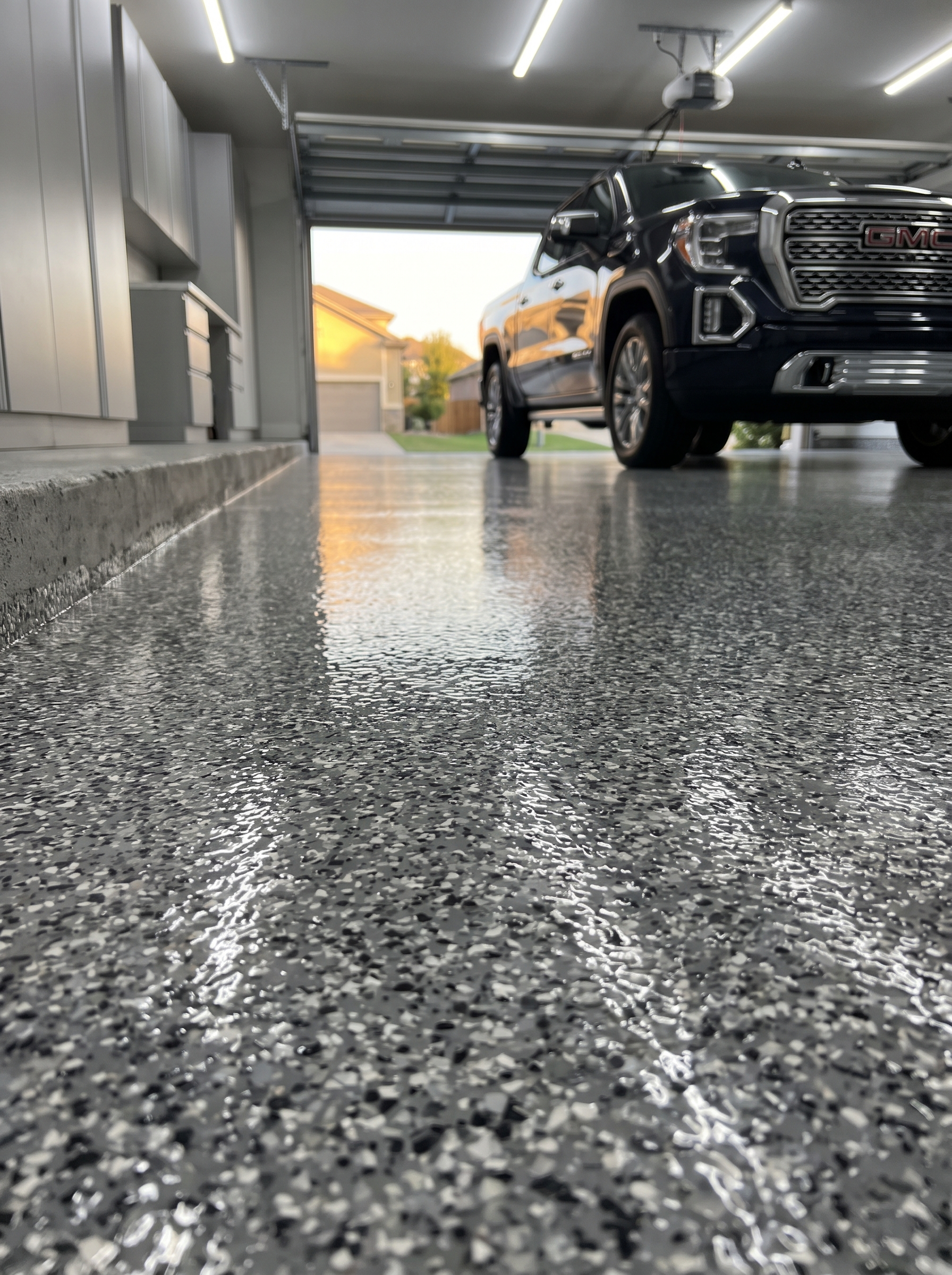
Every other garage floor ad says polyurea or polyaspartic is 4x stronger than epoxy, so plenty of homeowners ask for a polyurea floor “so it’ll last.” We pulled the manufacturer technical data sheets, the lab numbers each company publishes for its own product, and lined them up.
Short version: nothing is 4x stronger than anything. Each chemistry wins a different test, and the base coat is where the choice matters most.
The “4x stronger than epoxy” myth
“4x stronger” has to mean 4x better on some test. Here is every strength test on the data sheets, and whether anything clears 4x:
| Test | Epoxy | Polyaspartic | Polyurea | Anything 4x better? |
|---|---|---|---|---|
| Tensile (pull apart) | 4,500 to 9,600 psi | 2,760 to 7,500 psi | 2,800 to 4,000 psi | No. Epoxy leads |
| Compressive (crush) | 7,500 to 13,000 psi | 9,400 to 12,000 psi | Rarely published | No. Tie |
| Adhesion (pull off concrete) | Concrete breaks first | Concrete breaks first | Concrete breaks first | No. Tie |
| Hardness (Shore D, max 100) | 75 to 84 | 33 to 86 | 50 to 60 | No. Can’t happen on a 100-point scale |
| Abrasion (wear) | 36 to 50 mg lost | 9 to 65 mg lost | 11 to 70 mg lost | Sometimes. Best polyaspartics wear 1.7 to 5.6x less |
So where does the number come from? We found three sources:
- A wear number called strength. Abrasion is the only test where polyaspartic pulls a multiple ahead. “Wears about 4x better” became “4x stronger.”
- A weak epoxy as the comparison. The best-known “20x stronger” claim, on a big-box DIY kit, is reported to come from one abrasion test against one-part epoxy paint. Professional floors use 100% solids, two-part epoxy.
- A made-up epoxy number. One spray polyurea maker’s article gets to “four times stronger in tensile” by listing epoxy at 700 to 1,500 psi. Every 100% solids flake-system epoxy we read lists 4,500 to 9,600.
When a quote says 4x stronger, ask two questions: stronger on which test, and compared to which epoxy? The rest of this post walks through each test.
Polyurea, polyaspartic, and epoxy in one table
| 100% solids epoxy | Polyaspartic | Polyurea | |
|---|---|---|---|
| Tensile strength (psi) | 4,500 to 9,600 | 2,760 to 7,500 | 2,800 to 4,000 |
| Hardness (Shore D) | 75 to 84 | 33 to 86 | 50 to 60 |
| Stretch before breaking | 6 to 30% | 5 to 100% | 95 to 500% |
| Abrasion loss (Taber, lower is better) | 36 to 50 mg | 9 to 65 mg | 11 to 70 mg |
| Bond to concrete | Concrete breaks first | Concrete breaks first | Concrete breaks first |
| Slab moisture it can handle | Up to 25 lb (vapor-barrier primers) | 3 lb | 3 lb or less |
| Working time | 30 to 90 minutes | 10 minutes to 2 hours | Seconds (spray) to 50 minutes |
| Yellows in sunlight | Yes | No | Aromatic versions do |
| Best job | Garage base coat | Garage topcoat | Truck beds and liners |
Ranges come from the data sheets listed at the bottom of this post. Lab values are “typical,” and test conditions vary by brand, so read them as ranges and not exact rankings.
Polyaspartic is a type of polyurea
Pure polyurea cures in 6 to 10 seconds. It goes on with a heated, two-hose spray rig, which is why it shows up on truck beds and tank linings. Polyaspartic is the same family of chemistry slowed down so a crew can squeegee and roll it, and the good ones are UV-stable.
Product names don’t help. One brand sells a “polyurea basecoat” whose own data sheet calls it a polyaspartic. Another sells a “polyurea” base that is a polyurea and polyurethane hybrid. When someone quotes you a polyurea garage floor, ask for the data sheet. Most of the time it’s a polyaspartic.
How coating strength is measured
Strength is measured in psi, pounds of force per square inch, and there are five tests that matter:
- Tensile: how hard you can pull it before it tears.
- Compressive: how much it takes to crush it.
- Flexural: how far it bends before it breaks.
- Adhesion: how hard you can pull it off the concrete.
- Hardness: how well it resists dents and scratches, on a 0 to 100 Shore D scale.
Here is how each one comes out.
Tensile strength: epoxy vs. polyurea vs. polyaspartic
| Product | Type | Tensile (psi) |
|---|---|---|
| Simiron 1100SL | Epoxy | 9,600 |
| Epoxy2U 6150RC | Epoxy | 8,900 |
| Penntek IHE 4000 | Epoxy | 8,102 |
| MF 2600 | Epoxy | 6,500 |
| MPC-280 | Polyaspartic | 6,500 to 7,500 |
| Citadel RG-80X | Polyaspartic | 6,000 |
| Simiron Polyaspartic HS | Polyaspartic | 4,000 |
| Spartacote Flex SB 250 | Polyaspartic | 2,760 |
| Penntek XP 275 | Hand-applied polyurea hybrid | 4,000 |
| E-Green Polyurea | Hand-applied polyurea | 3,700 |
| LINE-X XS-350 | Spray polyurea | 3,432 |
| Rhino Extreme HP 11-50 | Spray polyurea | 2,800 to 3,200 |
Epoxy leads, the better polyaspartics come close, and polyurea sits at roughly half of a good epoxy.
Compressive and flexural strength
Epoxies list 7,500 to 13,000 psi compressive. The polyaspartics that publish it list 9,400 to 12,000, so that one is a tie. Most polyaspartic and polyurea sheets don’t list compressive or flexural strength at all. The epoxies that list flexural strength run 5,500 to 12,800 psi. You can’t claim a coating is stronger on a test it was never run on.
Adhesion: the concrete breaks first
Every chemistry reports roughly 300 to 600 psi pull-off strength, and nearly every sheet adds the same note: the concrete failed. A garage slab only holds together at about 300 to 600 psi in tension, according to the National Ready Mixed Concrete Association. Once a coating bonds harder than the slab, the pull test tears out concrete, and a higher number means nothing. No coating can be 4x better at adhesion when all of them outlast the concrete.
Hardness
Shore D tops out at 100. Epoxies land at 75 to 84, polyaspartics at 33 to 86, and polyurea base coats at 50 to 60. “4x harder” is impossible on this scale. Polyurea comes out softest, which is part of why it flexes.
Abrasion: where polyaspartic wins
This is the one test where a multiple shows up. On a Taber abrasion test (same wheel, same weight, 1,000 cycles), the best polyaspartics lose 9 to 30 mg of material, where a good epoxy loses 36 to 50 mg. That’s 1.7 to 5.6 times better. It isn’t universal: one polyaspartic topcoat lost 65 mg, worse than the epoxies.
That wear resistance is why polyaspartic belongs on top of the floor, where tires and boots grind on it.
Flexibility: where polyurea wins
Polyurea stretches 95 to 300% before breaking when hand-applied, and up to 500% when sprayed. Epoxy stretches 6 to 30%. That matters on a truck bed that flexes and takes impacts. A garage slab doesn’t flex, and a soft base coat under a hard topcoat gives the floor nothing to do with that stretch.
Moisture decides the base coat
Concrete pushes water vapor up through the slab around the clock, and moisture is the #1 reason a coating warranty claim gets denied. So the moisture numbers matter more than any strength test.
| Base coat | Slab moisture limit (lb per 1,000 sq ft per 24 hr) | Vapor permeance (perms, lower is better) |
|---|---|---|
| Standard epoxy, polyaspartic, or polyurea base | About 3 lb, or 75% RH in the slab | 0.5 to 0.8 |
| Moisture-vapor-barrier epoxy primer | 18 to 25 lb, or 95 to 99% RH | 0.06 to 0.3 |
Only one kind of base coat is built to handle a damp slab: a vapor-barrier epoxy. We didn’t find a polyaspartic or polyurea base rated anywhere close. Several polyaspartic and polyurea data sheets tell the installer to lay a moisture-barrier primer first when the slab reads high.
Best base coat for a garage floor
- Moisture-vapor-barrier epoxy. Hard, strong, soaks into ground concrete, and rated for 18 to 25 lb of vapor.
- Standard 100% solids epoxy. Same strength on a dry slab, less moisture tolerance.
- Polyaspartic base. Strong enough, but it flash-cures on the surface instead of wetting into the pores, and it wants a dry slab.
- Polyurea base. The softest and lowest in tensile strength of the three, with the least time to work it into the concrete.
What we put down
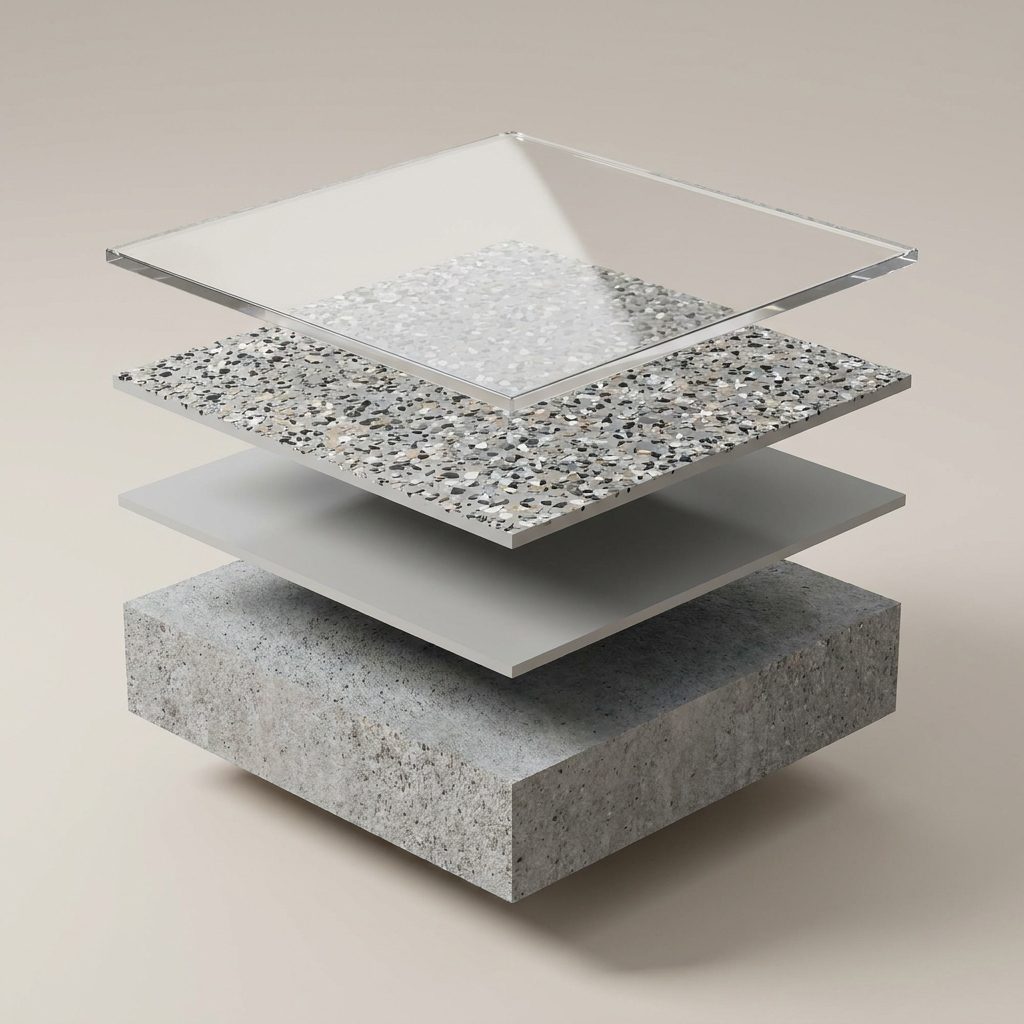
We use the data sheet numbers to pick the layers, and we publish ours:
| Layer | Product | Tensile | Compressive | Hardness | Other |
|---|---|---|---|---|---|
| Base | E4E VBP vapor barrier epoxy | 5,550 psi | 9,800 psi | Shore D 80 to 90 | Rated to 18 lb of vapor at 6 mils |
| Top | Super Turtle Poly polyaspartic | 7,000 to 8,000 psi | 9,000 to 10,000 psi | Shore D 76 to 77 | UV-stable, 100% elongation |
Our polyaspartic topcoat lists higher tensile strength than our epoxy base. We’re fine with that. The base has a different job: grab the ground concrete and hold back moisture. The topcoat takes the wear and the sun. That’s the same topcoat material a 1-day crew uses. The difference is the epoxy under it. More on that in polyaspartic vs. epoxy and 1-day floors.
We meter every slab for moisture before we coat it, and our warranty covers moisture-related peeling in writing. Read what a lifetime warranty usually leaves out before you compare quotes.
The bottom line
If a company says their polyurea garage floor coating is 4x stronger than epoxy, ask two things: stronger on which test, and compared to which epoxy? The data sheets say epoxy is the stronger base coat, polyaspartic is the tougher topcoat, and polyurea is built for truck beds. A floor that uses epoxy on the bottom and polyaspartic on top gets the best number from each.
We install that 2-day system across Granbury and the surrounding North Texas towns, and you can see what it costs before we come out.
Sources
Manufacturer technical data sheets:
- Simiron 1100SL epoxy and Simiron MVB
- Simiron Polyaspartic HS
- MF 2600 epoxy
- Penntek IHE 4000 epoxy, NF 450 primer, XP 275, and NX 300
- Citadel PLE-100 epoxy and RG-80X polyaspartic
- Epoxy2U 6150RC epoxy
- MPC-280 polyaspartic
- Spartacote Flex SB 250 and Flex Pure
- Resinwerks Vapor Barrier Epoxy
- E-Green Polyurea
- Rhino Extreme HP 11-50
- E4E VBP and Super Turtle Poly
Concrete and industry references:
Common questions
Is polyurea better than epoxy for a garage floor?
Not as a base coat. On the manufacturer data sheets, 100% solids flake-system epoxies list 4,500 to 9,600 psi tensile strength and a Shore D hardness around 75 to 84. Hand-applied polyurea base coats list about 3,700 to 4,000 psi and Shore D 50 to 60. Polyurea stretches much further, which is useful on a truck bed, but a garage base coat needs to be hard, bond into the concrete, and hold back moisture. Epoxy does all three better.
What is the difference between polyurea and polyaspartic?
Polyaspartic is a type of polyurea. Pure polyurea cures in seconds and has to be sprayed with a heated rig. Polyaspartic is a slowed-down, UV-stable version made so a crew can roll it by hand. Many garage products sold as polyurea are polyaspartic or a polyurea hybrid when you read the data sheet.
Is polyaspartic 4x stronger than epoxy?
No data sheet we found supports it. On tensile, compressive, and hardness tests, 100% solids epoxy and polyaspartic land in the same range. Polyaspartic wins on abrasion resistance, often by 2 to 5 times on the same test, and that is likely where the 4x line started.
What is the best base coat for a garage floor?
A 100% solids epoxy, and a moisture-vapor-barrier epoxy if the slab has any moisture. Epoxy primers are the only base coats on the market rated to hold back 18 to 25 pounds of slab moisture. Standard polyurea and polyaspartic base coats want the slab at 3 pounds or less.
What is the best topcoat for a garage floor?
A UV-stable polyaspartic. It resists abrasion, hot tires, and chemicals, and it stays clear in sunlight. Epoxy yellows in direct sun, so it belongs under the flake, not on top.