Shop Floor Epoxy: What It Takes to Coat a Working Shop
A shop floor takes more abuse than a garage. How shop floor epoxy, paint, and flake systems compare, and what it costs to coat a workshop or metal building.
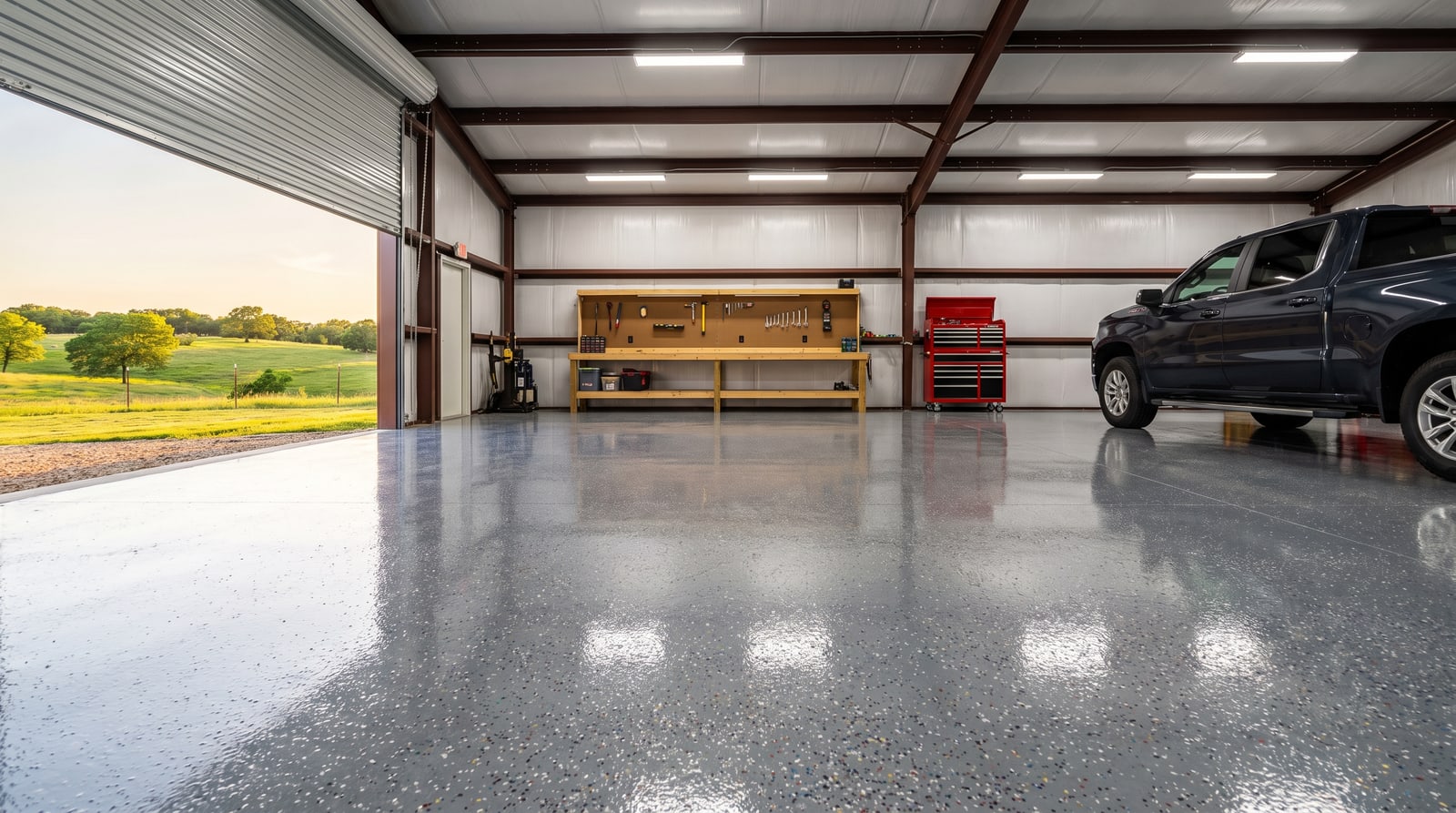
A shop floor lives a harder life than a garage floor. Jack stands, dropped sockets, a creeper rolling back and forth, a tractor with mud packed in the treads, oil and brake cleaner and whatever else ends up on the concrete. Then Texas summer bakes the slab and hot tires roll in on top of it.
Around Hood, Parker, and Erath County, half the good shops are metal buildings sitting on a slab someone poured a decade ago. Those floors can look fantastic. They just ask more of a coating than a two-car garage does.
Why shop floors are harder on coatings
Four things separate a shop from a garage:
The concrete is usually rougher. Shop and barn slabs often got a broom finish, or they’ve been soaked in oil for years, or they were poured fast without much care. There’s more to grind, more to repair, and more contamination to pull out before anything bonds.
The loads are heavier. A garage sees two cars. A shop sees a truck, a trailer tongue, jack stands, an engine hoist, maybe a tractor. Weight isn’t the enemy on its own; concentrated point loads on a thin film over weak prep are.
The chemicals are worse. Gas, diesel, hydraulic fluid, brake cleaner, battery acid. A shop floor gets what a garage floor only sees on a bad day.
Moisture is more likely. This is the big one for metal buildings, and it’s the reason some shop floors fail no matter who coats them.
The metal building moisture problem
A lot of shops and barns around here were poured without a vapor barrier under the slab. Water in the soil wicks up through the concrete and pushes against the bottom of any coating. It’s the same failure that kills 1-day polyaspartic floors and hardware-store kits, just more common in a shop.
We check for it before we quote. Tape a couple feet of plastic to the slab, leave it overnight, and see if there’s condensation underneath in the morning. If your slab is pushing moisture, that changes the plan, and you deserve to know before anyone takes your deposit.
A thick, bonded epoxy base is what resists that pressure. A rolled-on film has nothing to fight it with.
Shop floor paint vs. epoxy vs. a full system
People search all three, so here’s the honest hierarchy:
| Shop floor paint | DIY epoxy kit | Our flake system | |
|---|---|---|---|
| What it is | A thin latex or 1-part film | Thin 2-part epoxy over etched concrete | Ground slab, epoxy base, full flake, polyaspartic top |
| Prep | Clean and roll | Acid etch | Diamond grind, cracks and joints repaired |
| Oil and chemical resistance | Poor | Fair | Strong |
| Hot tire pickup | Fails | Common | Resisted |
| Typical life in a working shop | A year or two | 1 to 3 years | 15 to 20+ years |
| Slip resistance | Slick when wet | Slick unless you buy additive | Flake gives grip |
Shop floor paint is cheap and it looks fine for a season. In a shop that actually gets used, it wears through in the traffic lanes and starts lifting where the tires sit. We break down the kit side of this in detail in what the DIY kits don’t tell you.
What we put down in a shop
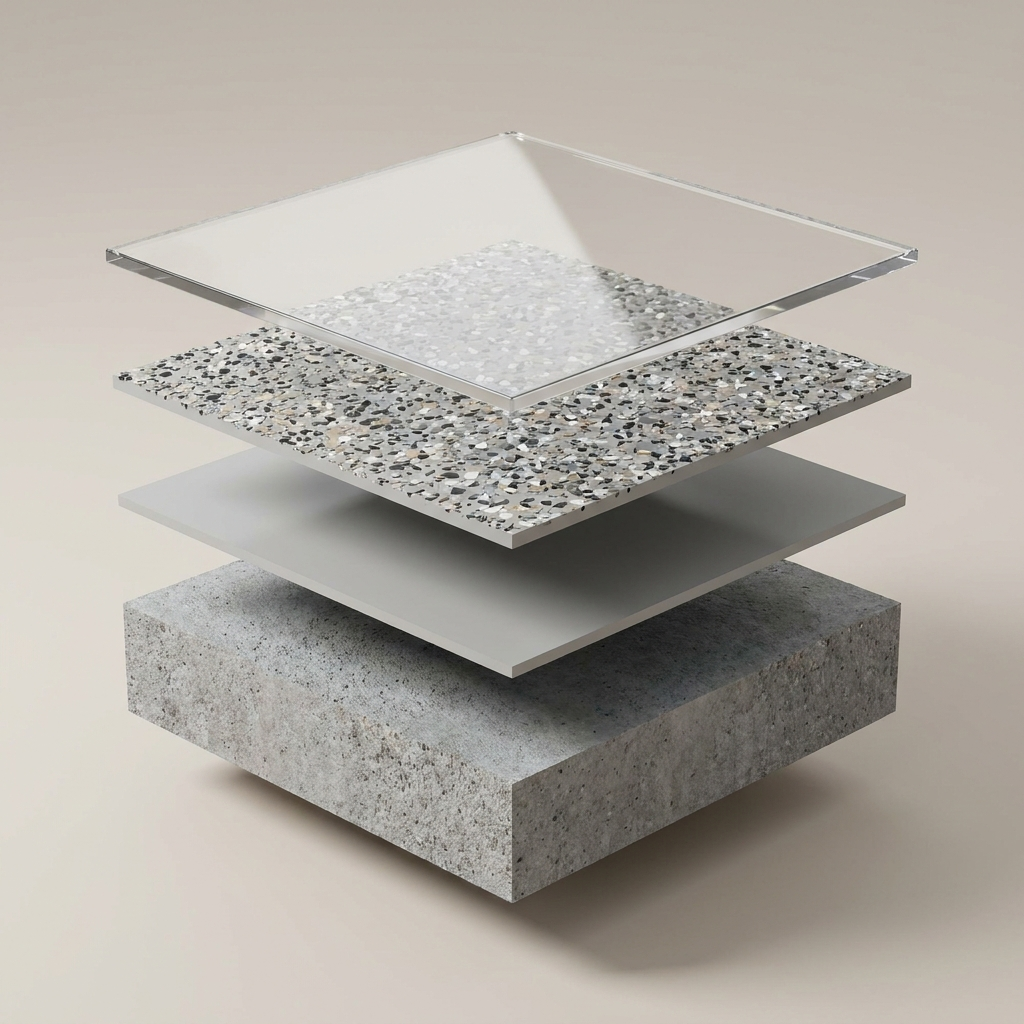
Same four layers we use in a garage, sized for a bigger slab:
- Diamond-ground concrete. More grinding than a garage usually, because shop slabs are dirtier and rougher. Oil spots get cut out and treated.
- Crack and joint repair. Older shop slabs move and crack. We fill them before coating instead of letting them telegraph through.
- A high-build epoxy base. Bonds into the ground profile and stands up to moisture from below.
- Full flake broadcast and a UV-stable polyaspartic topcoat. The flake gives grip and hides wear. The polyaspartic takes the chemicals, the hot tires, and the sun coming through the roll-up door.
What it costs
Same flat rate as our garages: $6 per square foot, all-inclusive. No hidden charges, and the price covers prep, grinding, repair, the epoxy base, the flake, the topcoat, labor, and cleanup.
| Shop size | Square feet | Roughly |
|---|---|---|
| 24 x 30 | 720 | $4,320 |
| 30 x 40 | 1,200 | $7,200 |
| 40 x 60 | 2,400 | $14,400 |
Bigger floors take longer, but the rate doesn’t change. Add $1 per square foot if you want us to move everything out and put it back, which on a packed shop is usually worth it. More on how we price in the cost guide.
Two honest limits
We’d rather tell you now than after.
Hot slag will mar any coating. If you weld on the floor, sparks and slag can burn the topcoat. Same is true of every coating on the market. Throw a welding blanket or a piece of sheet metal down where you strike arcs and it’s a non-issue.
A failing slab is a concrete problem, not a coating problem. If your shop floor is heaving, badly spalled, or cracked from settling, a coating won’t fix the cause. We’ll tell you if that’s what we’re looking at.
Why a coated shop floor is worth it
Beyond looks, three things people notice immediately:
- It cleans up. Sweep it, hose it, wipe up the oil. No more dust coming off bare concrete onto everything you own.
- It’s brighter. A light flake floor bounces the shop lights around. You’ll notice it under a hood.
- It doesn’t hold stains. Bare concrete drinks everything you spill. A sealed floor doesn’t.
Pick your color from dozens of flake blends. Grays hide the most in a working shop; earth tones hide the dirt that follows a tractor in.
The bottom line
A shop floor takes more than a garage floor, so it needs more than a rolled-on coat. Grind the slab, check it for moisture, bond a thick epoxy base into it, and seal it under flake and polyaspartic. Do that and a shop floor outlasts the truck you park on it.
More on how we handle working shops, including sequencing bay by bay so you keep turning cars, on our shop floor coating page.
We coat shops, barns, and metal buildings across Granbury, Weatherford, Stephenville, and Glen Rose. Send us the dimensions of your building and we’ll get you a number.
Common questions
How much does it cost to epoxy a shop floor?
We coat shops at $6 per square foot, all-inclusive. A 30x40 metal building is 1,200 square feet, so about $7,200. A 24x30 shop runs around $4,320. The rate covers grinding, crack repair, epoxy base, full flake, polyaspartic topcoat, labor, and cleanup.
Will a shop floor coating hold up to a floor jack or a tractor?
A properly ground and bonded system handles vehicles, jack stands, and equipment. What hurts coatings is point loading on a thin film over weak prep. Thickness and bond are what carry the weight, which is why a rolled-on paint job fails under the same use.
Can you coat a metal building or barn slab?
Usually yes. The catch with metal buildings is that a lot of those slabs were poured without a vapor barrier, so moisture pushes up through the concrete. We test for it before quoting, because a coating over a wet slab will lift no matter who installs it.
Is shop floor paint good enough?
For a floor you rarely use, maybe. Shop floor paint is a thin film that wears through where you walk, roll, and park. In a working shop with oil, dropped tools, and hot tires, it usually starts lifting within a year or two.