Garage Floor Sealer vs. Coating: What You Actually Need
A sealer keeps concrete looking like concrete. A coating gives you a new floor. Here's which one you actually need, and the mistake that costs you later.
Search “garage floor sealer” and you’ll get two completely different products sold under the same word. One soaks into your concrete and disappears. The other sits on top and gives you a new floor. They cost different money, they last different lengths of time, and they solve different problems.
Most people searching that phrase want their garage to stop being dusty, stained, and depressing. Whether a sealer gets you there depends on something nobody asks first: do you want a nicer concrete floor, or do you want to stop looking at concrete?
What a garage floor sealer actually is
Two families of product wear the name, and the difference matters more than the brand does.
Penetrating sealers (silanes, siloxanes, and silicates) soak in and react with the concrete itself. They leave no film worth speaking of. Your floor looks the same after as it did before, maybe a shade darker. What you get is concrete that drinks less water, dusts less, and gives you a few minutes to wipe up a spill before it soaks in. Because there’s no film, there’s nothing to peel, scratch, or lift.
Topical sealers (usually acrylic) lay a thin film on the surface. They darken the concrete and add a slight sheen, which is why a lot of people like the look. They’re cheap and easy to roll on. They also wear through where you walk and park, and they’re the ones with the hot-tire problem below.
Densifiers get sold in the same aisle. They’re a related idea: a liquid silicate that hardens the top of the slab and cuts down dusting. Useful, and often paired with a penetrating sealer rather than replacing it.
What a coating is
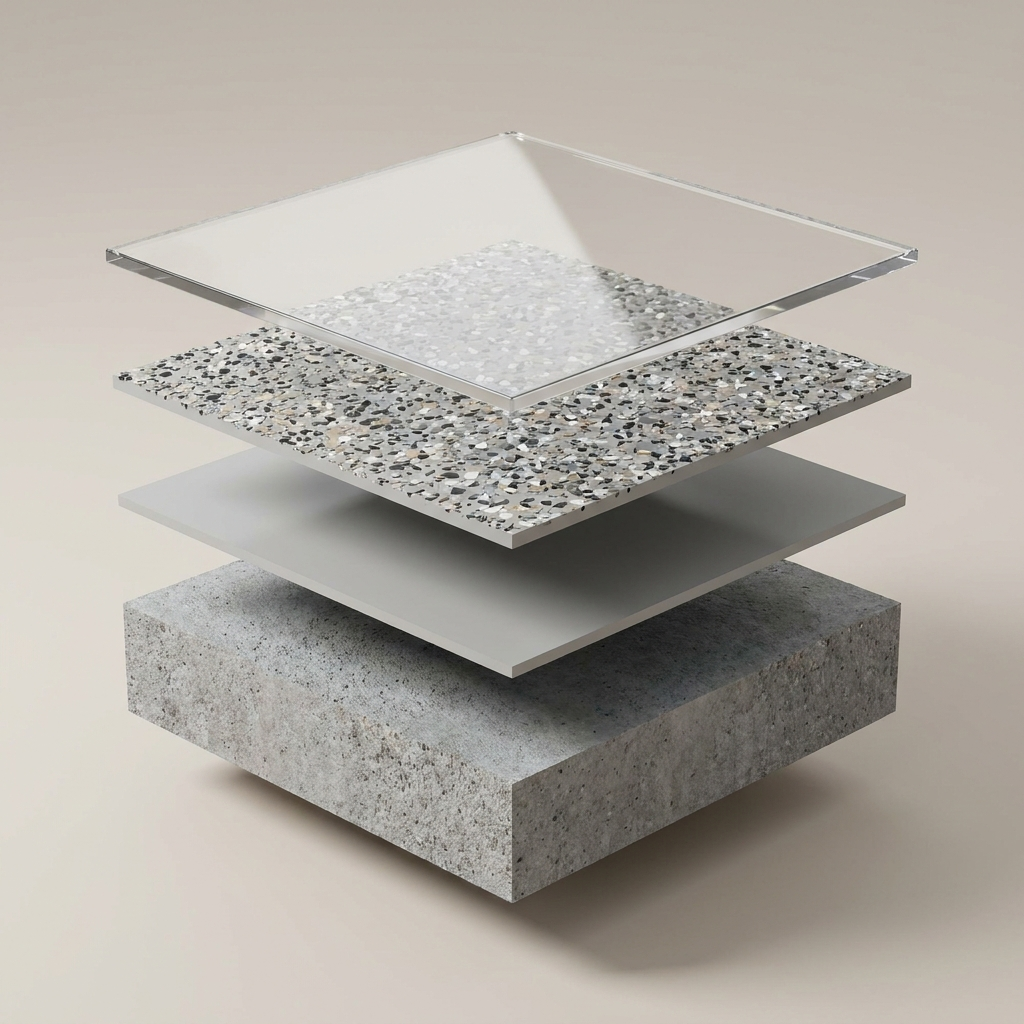
A coating isn’t a stronger sealer. It’s a different category. Our system runs a diamond-ground slab, a high-build epoxy base bonded into it, a full broadcast of color flake, and a UV-stable polyaspartic topcoat. That stack lands in the 20 to 40 mil range, roughly the thickness of a credit card, where a penetrating sealer measures effectively nothing and an acrylic runs a couple of mils.
You’re not buying more protection. You’re buying a different floor. The full breakdown of that system covers why each layer is there.
Side by side
| Penetrating sealer | Acrylic topical sealer | Flake coating system | |
|---|---|---|---|
| What it does | Soaks in, reacts with the slab | Thin film on the surface | New surface bonded to the slab |
| Thickness | Effectively none | 1 to 3 mils | 20 to 40 mils |
| Looks like | Bare concrete | Concrete, darker, with sheen | Whatever color you pick |
| Hides stains | No, seals them in | Barely | Yes |
| Hot tire pickup | Nothing to lift | Common failure | Resisted |
| Can it peel | No film, so no | Yes | Bonded into ground concrete |
| Slip when wet | Same as concrete | Slicker than concrete | Flake gives grip |
| Redo every | Several years | 1 to 3 years | 15 to 20+ years |
| Ballpark | A couple hundred in material | A couple hundred in material | $6 per square foot installed |
When a sealer is the right call
We install coatings for a living and we’re still going to say it: sometimes a sealer is the smarter buy.
- You actually like concrete. Some people want a clean, honest slab, not a showroom. A sealer respects that.
- The slab isn’t worth the money. A detached shop you’re in twice a month, a carport, a storage garage. Seal it and move on.
- It’s a rental or you’re selling. Cheap, fast, tidy.
- The concrete is new and you want to protect it. Sealing a fresh, clean slab is a reasonable thing to do while you decide what you want long term. Read the next section first, though.
- Dust is the whole complaint. If your only problem is gray powder on everything, a densifier and a penetrating sealer fix that for a fraction of a coating.
When a sealer won’t do what you’re hoping
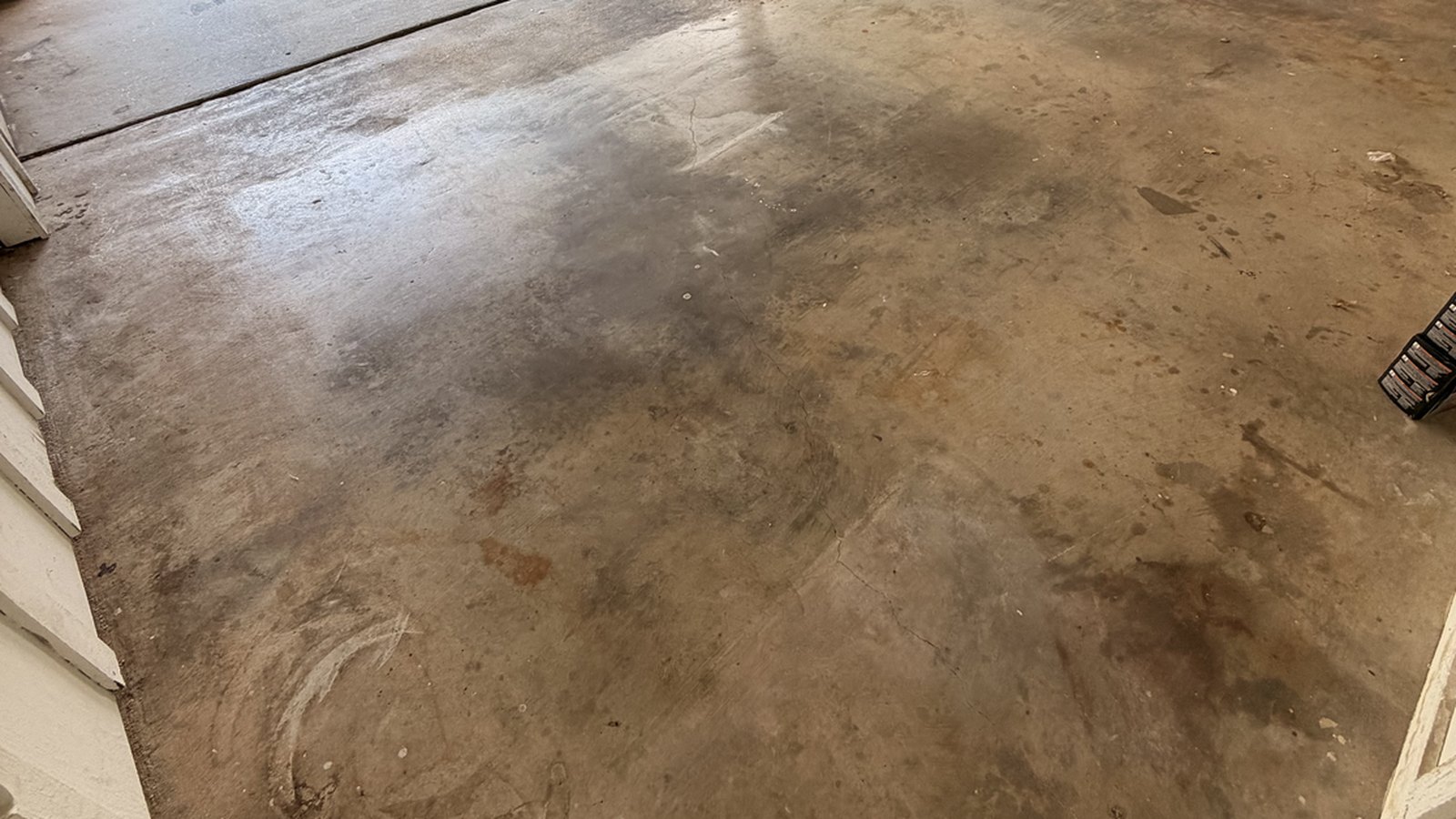
The floor in the photo at the top of this page is a real slab from one of our jobs. Oil, rust, tire marks, a crack, and forty years of whatever got spilled. Seal that floor and you own a sealed version of that floor.
That’s the part the product pages skip. A sealer doesn’t hide anything. It locks it in. If your reason for searching is that the floor looks bad, a sealer is the wrong tool. Same goes if you want color, if you want the floor to be brighter, or if you want a crack to stop being a crack.
The hot tire problem
Texas summers are where acrylic sealers earn their reputation. Tires come home hot enough to soften a thin film, and when they cool they grip it and pull. The film comes up in patches shaped like your tires.
Penetrating sealers sidestep this because there’s no film to grab. A bonded flake system resists it because the polyaspartic on top cures hard and the whole stack is keyed into ground concrete. An acrylic sits in the worst spot: thick enough to lift, thin enough to lose.
The mistake that costs you later
Here’s the one thing worth knowing before you buy a jug of anything.
Sealing a floor now makes coating it later more expensive.
Epoxy bonds by keying into open concrete pores. A sealer’s entire job is filling those pores. Put a coating over a sealed slab and it has nothing to grab, so it lifts. This isn’t a fringe concern. It’s printed on the kits: Rust-Oleum’s own instructions tell you to strip any sealer before you start, and the acid etch in the box won’t do it. We covered what else those sheets say if you’re curious.
Removing a sealer means diamond-grinding it off. We grind every floor anyway, so it isn’t a disaster on our end. But if you’re doing it yourself, you just added a grinder rental and a day to a job you thought was a weekend.
The rule is simple. If there’s any chance you’ll want a coated floor down the road, don’t seal it in the meantime. A bare slab is easier to work with than a sealed one.
Moisture, and why it cuts both ways
A lot of slabs around Granbury and Weatherford went down without a vapor barrier under them. Water in the soil wicks up through the concrete and pushes against whatever is on top.
A penetrating sealer handles this fine, because it breathes. There’s no film for vapor to push off. This is one of the few places a sealer genuinely beats a cheap coating.
An acrylic topical can blister and cloud when moisture pushes into the back of the film. And a thin coating laid straight on concrete is exactly the failure we write about with 1-day systems. The answer isn’t to avoid coatings. It’s to use a high-build epoxy base that’s built to take the pressure, and to test the slab before anyone quotes you. We tape plastic to the floor overnight and look for condensation in the morning. It costs nothing and it changes the plan.
How to seal a garage floor, if that’s your call
No upsell here. If a sealer is what you want, do it in this order:
- Empty it and degrease it. Any oil you leave is a spot the sealer skips.
- Clean the concrete properly. Sweep, scrub, rinse, and let it dry all the way through. Sealers go on dry slabs.
- Fix the cracks first. A sealer flows into a crack and does nothing about it.
- Test a corner. Products react differently on different slabs. Do a two-foot square and look at it the next day before you commit to the whole floor.
- Roll it thin and even. Most failures we see are from someone puddling it on. Two thin coats beat one heavy one.
- Give it the full cure on the label before you park.
That’s a real Saturday and a couple hundred dollars, and you’ll have a cleaner slab that still looks like a slab. For some people that’s the right answer.
What we’d tell you on the phone
If your floor is structurally sound and your complaint is dust, seal it. You’ll spend a couple hundred dollars and be happy.
If your complaint is that the floor looks bad, or you want a color, or you’re tired of every drip becoming permanent, a sealer will disappoint you and you’ll spend the money twice. Our system runs $6 per square foot, all-inclusive, which puts a standard two-car garage around $3,000 to $3,600. The cost guide breaks down where that goes, and you can pick from dozens of flake blends with the full recipe listed for each.
The bottom line
A sealer protects concrete. A coating replaces the look of it. Neither one is the upgraded version of the other, and the right question isn’t which is better. It’s whether you want a nicer concrete floor or you want to stop looking at concrete.
If it’s the first, buy a penetrating sealer and skip the acrylic. If it’s the second, don’t seal it first, because you’ll pay to grind it back off. We grind, coat, flake, and seal floors across Granbury, Weatherford, Aledo, Stephenville, and Glen Rose. Send us the size of your garage and we’ll get you a number either way.
Common questions
What is the difference between a garage floor sealer and a coating?
A sealer soaks into the concrete and leaves no meaningful film, so your floor still looks like concrete. A coating sits on top and gives you a new surface with its own color and thickness. A sealer protects what you have. A coating replaces the look of what you have.
Is a garage floor sealer worth it?
It is, if you like the look of concrete and want less dusting and easier cleanup for a couple hundred dollars in material. It isn't, if you want to cover stains, add color, or stop hot-tire pickup. A sealer seals your floor's stains in rather than hiding them.
Can you epoxy over a sealed garage floor?
Not without removing the sealer first. Epoxy bonds by keying into open concrete, and a sealer's whole job is filling those pores. Acid etch won't take it off, so it has to be diamond-ground away. If there's any chance you'll coat the floor later, don't seal it now.
Does a garage floor sealer stop hot tire pickup?
A penetrating sealer has no film to lift, so there's nothing for a hot tire to pull up. An acrylic topical sealer is a different story, and hot-tire pickup is the most common way they fail in the Texas heat.
How long does a garage floor sealer last?
A penetrating sealer generally goes several years before it needs redoing, since there's no film to wear through. An acrylic topical wears in the traffic lanes and gets recoated far more often. A properly ground and bonded flake system is measured in decades instead.